
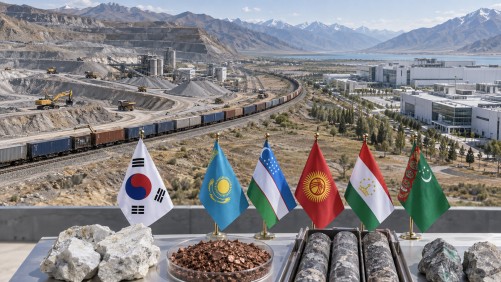
South Korea’s expanded collaboration with Central Asian nations is poised to significantly impact the global supply chain for critical minerals, vital to industries such as automotive, electronics, and energy. This initiative, emerging from the inaugural South Korea–Central Asia summit in Seoul, is set to reshape how these minerals are sourced and processed, with over 70 agreements and memorandums laying the groundwork for future cooperation.
The summit concluded with a commitment to biennial meetings and the establishment of a C5+1 forum for industry ministers, underscoring the strategic importance of this partnership. As South Korea aims to secure reliable sources of critical minerals, Central Asian countries like Uzbekistan and Kazakhstan are looking to leverage Korean expertise in exploration and advanced manufacturing to develop local processing capabilities and elevate their roles beyond mere raw material exporters.
South Korea’s proposition to integrate its technological prowess with Central Asia’s rich mineral resources is expected to span the entire supply chain. This includes everything from identifying mineral deposits and mining to processing and manufacturing high-value products. Additionally, rare metals research and training centers are being established in the region, fostering further innovation and expertise.
Uzbekistan, for instance, has proposed forming an investment alliance to focus on critical minerals, with plans to create processing clusters that encompass exploration, mining, and production. Meanwhile, Kazakhstan has expressed interest in cooperation on rare metals, nuclear and clean energy, artificial intelligence, and infrastructure projects, aiming to bolster its strategic partnership with South Korea.
Other Central Asian nations, such as Kyrgyzstan and Tajikistan, are also eager to engage with South Korea, particularly in the processing of minerals like antimony and tungsten. South Korea’s increasing involvement extends to transport and infrastructure projects across the region, reflecting a broader economic engagement.
This burgeoning Korean presence in Central Asia comes amidst a global race involving China, the United States, the European Union, and Japan, all seeking access to the region’s critical mineral resources. Central Asian governments are now more focused than ever on attracting investments that promise local processing and industrial production, rather than merely exporting raw materials. The next summit is slated for 2028 in Kazakhstan, promising further advancements in this crucial partnership.