
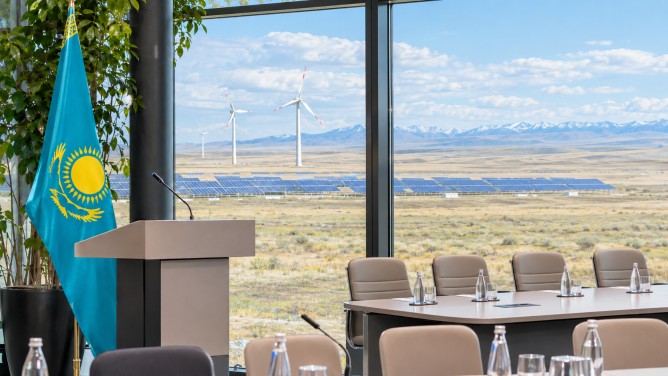
Kazakhstan has secured approximately $1.2 billion in deals at the COP31 climate summit in Antalya, Türkiye, marking a significant step towards enhancing its renewable energy infrastructure and achieving a low-carbon economy. These agreements include the development of a 150-megawatt wind farm in the Turkistan Region and a 1-gigawatt wind farm in the Kostanai Region. Additionally, the Aqyl Energy project aims to install 1.35 million smart gas meters to boost energy efficiency in gas-connected regions.
The agreements also address environmental challenges such as reducing methane emissions from gas networks and restoring degraded land in the Almaty Region. These measures align with Kazakhstan’s efforts to cut greenhouse gas emissions and are bolstered by international cooperation and carbon market mechanisms.
Further advancing its climate strategy, Kazakhstan is leveraging the Country Climate Investment Platform to connect various stakeholders with priority environmental projects. Through the Qazaqstan Just Energy Transition investment platform (QaJET), the country plans to mobilize around $20 billion to develop at least 10 gigawatts of renewable energy capacity by 2035. This initiative also includes modernizing the electricity grid, enhancing energy storage, and advancing electrification projects.
Kazakhstan has committed to reducing its greenhouse gas emissions by 17% below 1990 levels by 2035, with a potential 25% reduction contingent on international support. The long-term goal is to achieve carbon neutrality by 2060.
In addition to renewable energy, Kazakhstan is prioritizing water security and environmental protection in Central Asia, where climate change is straining regional water resources. The country’s initiatives include improving glacier and river monitoring, strengthening agricultural resilience, restoring the Northern Aral Sea, and protecting the Caspian Sea ecosystem. Kazakhstan has also advocated for the establishment of an international water organization under the United Nations to enhance global water cooperation.
According to Kazakhstan’s latest climate report, the country had achieved a 10.06% reduction in net greenhouse gas emissions from 1990 levels by 2024. Moving forward, Kazakhstan aims to strengthen environmental monitoring, expand renewable energy investments, and attract international financial and technological support to further its climate goals.